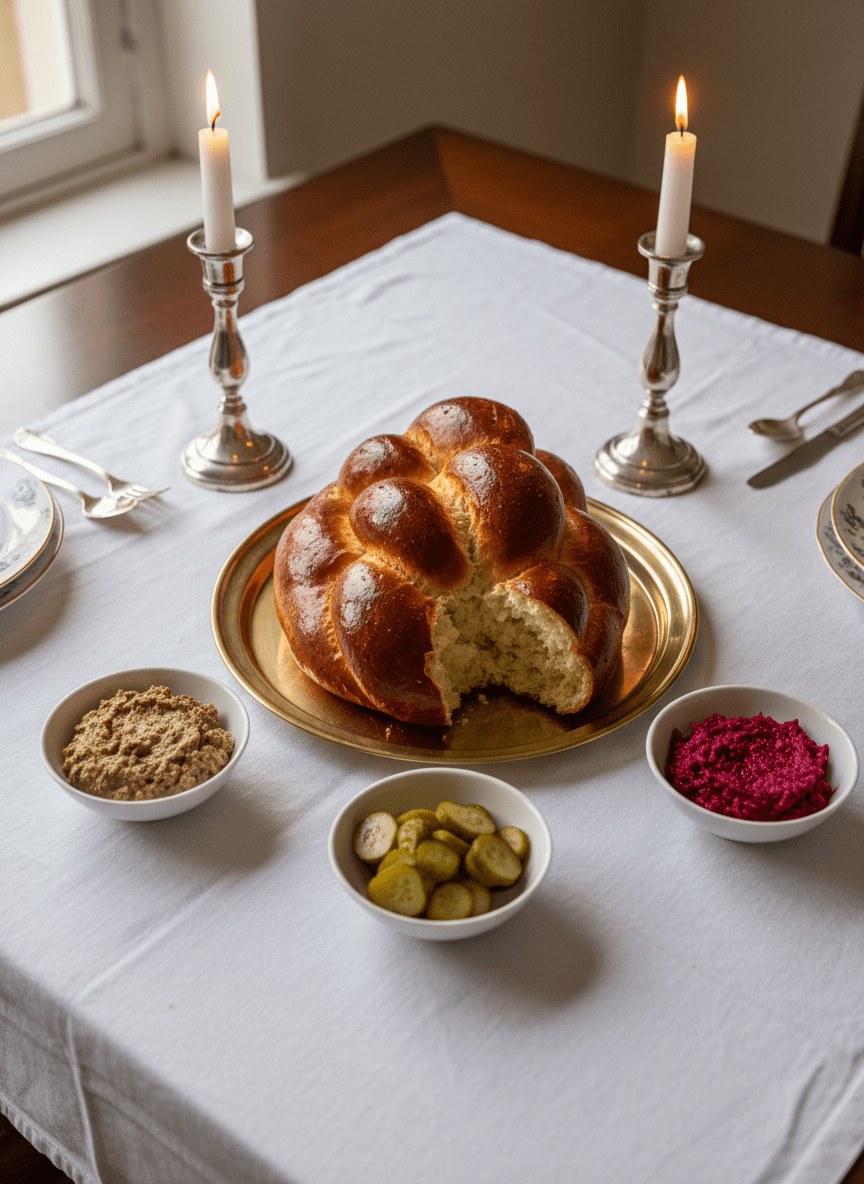
When most people picture Jewish food, they picture the deli. Towering pastrami on rye, bagels and lox, a steaming bowl of matzo ball soup. That food is wonderful and it is real, but it is only one branch of a much larger family. German Jewish food, the cuisine of the Yekkes, is an older and quieter tradition, and it is the one I grew up loving. That’s why this blog exists.
If you have never heard the word Yekke, you are in good company, and you are exactly the person I wrote this for. So pull up a chair. Let me introduce you to the corner of Jewish cuisine that nearly vanished, and to the food I am determined to keep alive.
Who are the Yekkes?
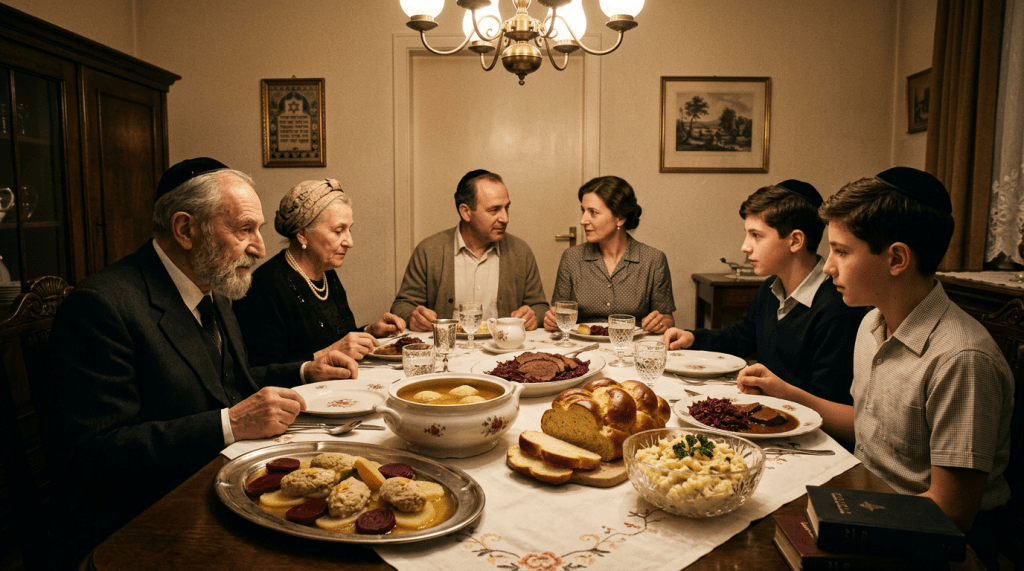
Yekke, and you say it YEK-uh, is the affectionate name for Jews whose roots run through the German-speaking lands of Central Europe. Think Germany, Austria, Switzerland, Alsace and the old towns of Bohemia and Moravia.
Nobody agrees entirely on where the word came from. The likeliest story is that it comes from the German word Jacke, meaning jacket, because German Jews kept wearing their short tailored suit jackets while their Eastern European cousins wore longer traditional coats. Over the years it grew into a gentle stereotype. Yekkes were the punctual ones, the orderly ones, the people who arrived exactly on time and wrote everything down. People usually say it with a smile, often Yekkes about themselves.
That same precision shows up at the table. A Yekke recipe tends to be exact, a Yekke Shabbat tends to start on the minute, and a Yekke cook tends to know precisely how her grandmother did it.
German Jewish food is older than you might think
Here is the part that surprises people. German Jewish cooking is not a curious little offshoot of Jewish cuisine. It is closer to the root.
The word Ashkenaz was the medieval Hebrew name for the German lands. Around a thousand years ago, the Jewish communities of the Rhineland, in cities like Speyer, Worms and Mainz, became the cradle of Ashkenazi Jewry. The customs, prayers, and foods that took shape there slowly spread eastward over the centuries. So when we cook Yekke food, we are cooking from the elder kitchen of the whole Ashkenazi world.
What makes German Jewish cuisine different
The deli food most of us think of as Jewish food is Eastern European, the cooking of Jewish communities in Poland, Russia, Lithuania and Ukraine. German Jewish cooking is its Western cousin, with a character all its own.
If one flavor says Yekke, it is sweet and sour. This love of süß-sauer runs straight through the cuisine, echoing the German countryside and dishes like sauerbraten. German Jewish cooks also leaned on goose where others reached for chicken, prized rendered goose and chicken fat, and brought a serious, café-influenced baking tradition to everything they touched.
The Jewish calendar and kashrut laws shaped the rest. In a country that adored pork and cooked in lard, kosher cooks built a whole cuisine around beef, goose and schmaltz instead. And because no fire could be lit on the Sabbath, they invented dishes that could sit in a low oven overnight and be ready, rich and tender, for Saturday lunch.
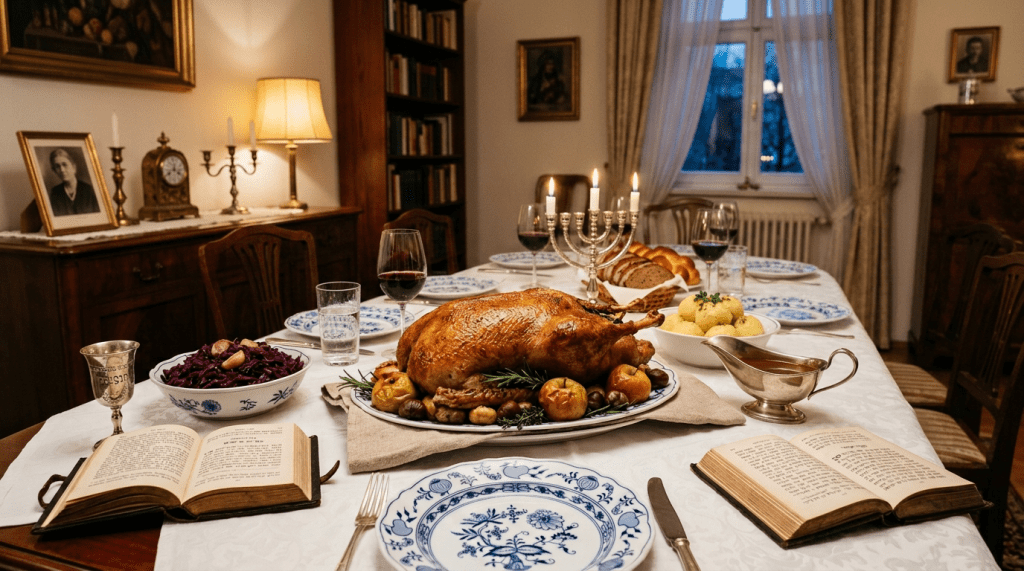
A few dishes sit at the heart of it all. There is honey cake, my Lekach, baked for a sweet new year. Sweet and sour brisket, the German Jewish version with its unmistakable tang, sits next. There is Berches, the German Jewish challah made with potato worked right into the dough. Roast goose, once the great celebration centerpiece, and Schalet, the slow Sabbath stew that is the German cousin of cholent. And then there is the baking, an entire world of plum cakes and crumb cakes cooling on the windowsill.
Why German Jewish food almost disappeared
The communities that created this food were shattered in the Holocaust. What survived, survived in the hands of those who fled.
Some carried these recipes to Britain. Many carried them to Israel, the Yekkes who arrived in the 1930s and brought German coffee culture and plum cake to a young country. And a great many carried them to New York, to the streets of Washington Heights, a neighborhood so full of German Jewish refugees that people fondly called it Frankfurt on the Hudson.
But in America, others mostly told the story. Eastern European Jews had arrived earlier and in far greater numbers, and their cooking became, in the popular imagination, simply Jewish food. The Yekke kitchen slipped quietly into the background, kept alive in family homes rather than in delis and cookbooks.
Why I am bringing it back
That is exactly why this blog is here.
This food nearly disappeared, carried out of Europe in memory more than in print. Every honey cake, every loaf of Berches, every pot of sweet and sour brisket is a small act of remembering. When we cook these dishes, we set a place at the table for the people who first cooked them. And I think the history is half the meal, so you will always find both here: the recipe and the story behind it.
Start here
If this has left you hungry, here is where I would begin. Try my honey cake for a taste of the new year, learn to bake Berches, the potato challah almost nobody outside the tradition knows, or read about what really sets German and Eastern European Jewish food apart.
Come cook with me
There is a whole world of German Jewish food to rediscover, and I would love to have you along. Join my email list and I will send you my free German Jewish holiday menu, plus a new recipe and story every week.
Pull up a chair. This beautiful, nearly forgotten food deserves to be tasted again.
With warmth from my kitchen to yours, Erika
 The Yekke Kitchen
Leave a comment