An elegant overhead view of a Shabbat table centered on a glossy, richly braided challah loaf with a deep mahogany crust and a soft, slightly torn end revealing its tender crumb. Surrounding it are small porcelain dishes of chopped liver, bright beet horseradish, and pickled cucumbers arranged with careful symmetry on a crisp white tablecloth. Silver candlesticks with softly glowing candles flank the bread, their reflections gleaming in a polished brass tray. Diffused warm evening light bathes the scene, enhancing golden tones and creating gentle, elongated shadows. The composition follows the rule of thirds with sharp focus on the challah and subtly blurred edges, evoking a refined, historically rooted Jewish German family table in photographic realism.

About The Yekke Kitchen

Some recipes are just instructions. Others keep people at the table long after they have gone.

The Yekke Kitchen is my love letter to German Jewish home cooking. This is the food of the Yekkes (that’s YEK-uh), Jews whose roots run through the German-speaking towns and cities of Central Europe. It is honey cake at the New Year and potato challah on a Friday night. Sweet and sour brisket, roast goose, and plum cake cooling on the windowsill. So much of this food nearly disappeared, carried out of Europe in memory more than in cookbooks. I am here to cook it back to life, one recipe and one story at a time.

Because that is the thing about Yekke cooking. Every dish comes with a history, and I think the history is half the meal. You will find both here, the how and the why, the technique and the tradition, always with room pulled up for one more chair.

A Little About Me

Hi, I’m Erika.

I cook from a forested five acres in the Pacific Northwest, the kind of place where the coffee goes cold because you got distracted by the trees. My taste-testers are four opinionated hens named Boudicca, Lagertha, Torvi and Ingrid, who supply the eggs and absolutely none of the patience.

I love to feed people and I would rather cook for twelve than for one. This little corner of the internet is my way of setting an extra place for you.

Pull up a chair

If you are here because you remember these flavors from a grandmother’s kitchen, welcome home. If you have never heard the word Yekke in your life, welcome all the same. There is a seat for you either way.

Come cook with me. Subscribe, say hello in the comments, and let’s keep this beautiful, nearly forgotten food alive together.

With warmth from my kitchen to yours, Erika

Headshot of Erika Montgomery in a white blouse with silver jewelry
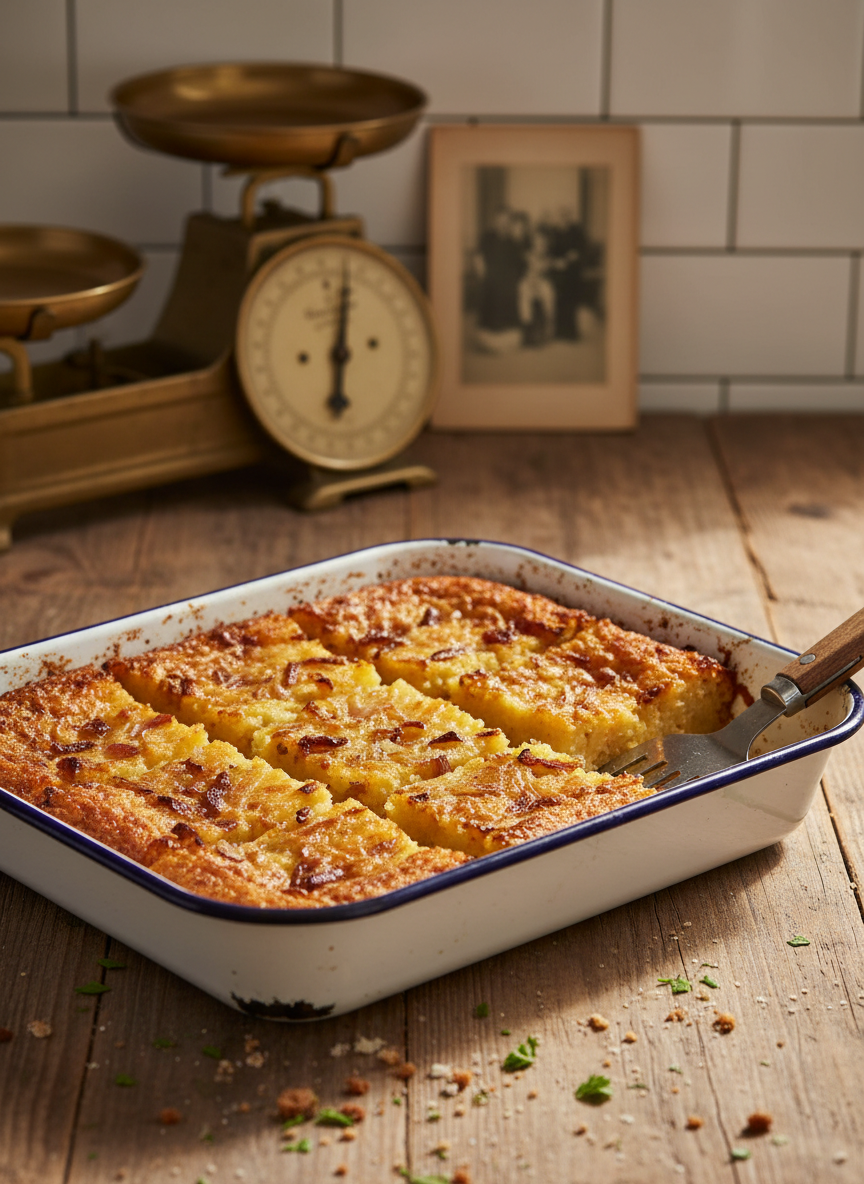
A rustic enamel baking dish filled with neatly arranged slices of potato kugel, each piece showing a perfectly browned, slightly crisp top and soft, tender interior dotted with caramelized onion. A serving spatula rests at the edge, its metal surface reflecting subtle highlights. The dish sits on a timeworn wooden farmhouse table sprinkled with a few stray crumbs and flecks of fresh parsley. In the softly blurred background, an old brass kitchen scale and a faded black-and-white photograph lean against white-tiled walls. Warm, diffused midday light from the right side adds depth and emphasizes the golden hues. Captured from a three-quarter angle with shallow depth of field, the image feels authentic, homely, and historically grounded while maintaining a sophisticated photographic realism.
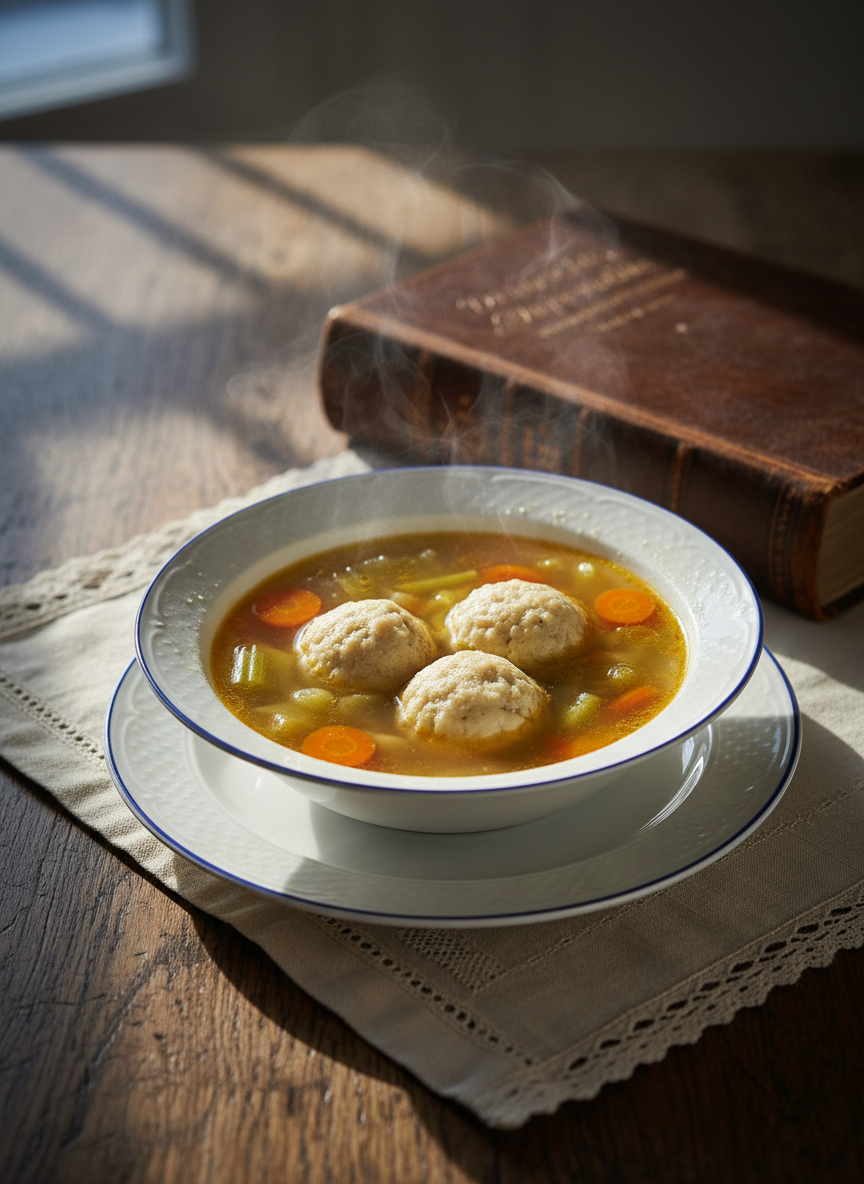
A steaming bowl of rich chicken soup in a fine white porcelain bowl with a delicate blue rim, filled with clear golden broth, thinly sliced carrots, celery, and a few perfectly shaped matzo balls floating on the surface. Droplets of condensation cling to the bowl’s exterior. The bowl stands on a lace-trimmed linen placemat atop an old oak table, next to a worn, leather-bound German-language cookbook opened to a soup recipe. Early morning winter light enters from a nearby window, cool and soft, contrasting with the warm glow of the soup. Shot at eye level with a gentle vignette and moderate depth of field, the mood is quietly nostalgic, sophisticated, and comforting in photographic realism.
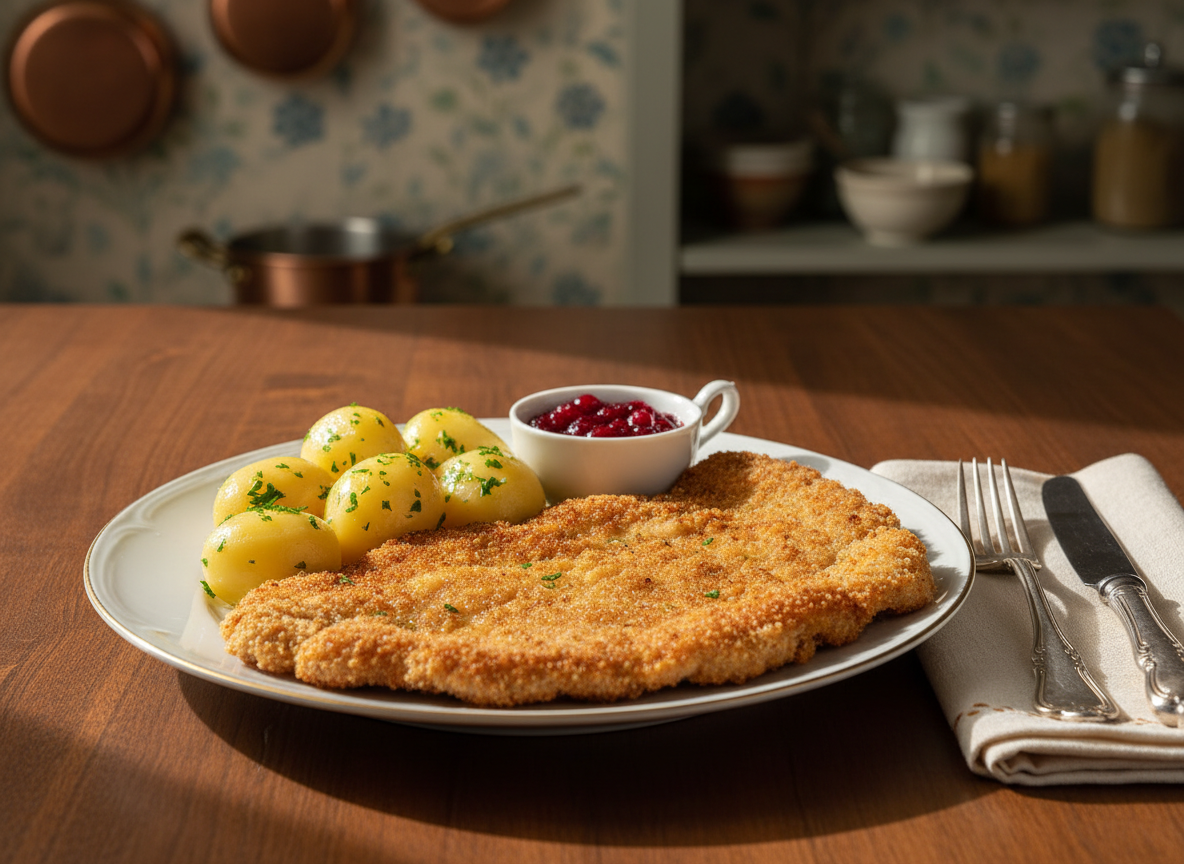
A meticulously plated serving of golden-brown schnitzel made from tender veal, its crisp, bubbly breadcrumb crust catching the light, accompanied by a neat mound of lemony parsley potatoes and a small dish of vibrant lingonberry compote. The plate rests on a smooth, dark wooden table with a subtle grain, beside a folded linen napkin and elegant vintage-style silverware. Soft afternoon daylight streams from the left, creating gentle highlights on the schnitzel’s texture and casting understated shadows. The background is softly blurred, revealing hints of antique kitchenware and a muted floral wallpaper. Photographic realism, shot from a slightly elevated angle with shallow depth of field, conveys a sophisticated yet comforting Ashkenazi home-kitchen atmosphere.

Reviews

An elegant overhead view of a Shabbat table centered on a glossy, richly braided challah loaf with a deep mahogany crust and a soft, slightly torn end revealing its tender crumb. Surrounding it are small porcelain dishes of chopped liver, bright beet horseradish, and pickled cucumbers arranged with careful symmetry on a crisp white tablecloth. Silver candlesticks with softly glowing candles flank the bread, their reflections gleaming in a polished brass tray. Diffused warm evening light bathes the scene, enhancing golden tones and creating gentle, elongated shadows. The composition follows the rule of thirds with sharp focus on the challah and subtly blurred edges, evoking a refined, historically rooted Jewish German family table in photographic realism.

Resi Baerwald

“These recipes taste like my Oma’s kitchen; seeing them preserved here feels like reclaiming a piece of our family history.”
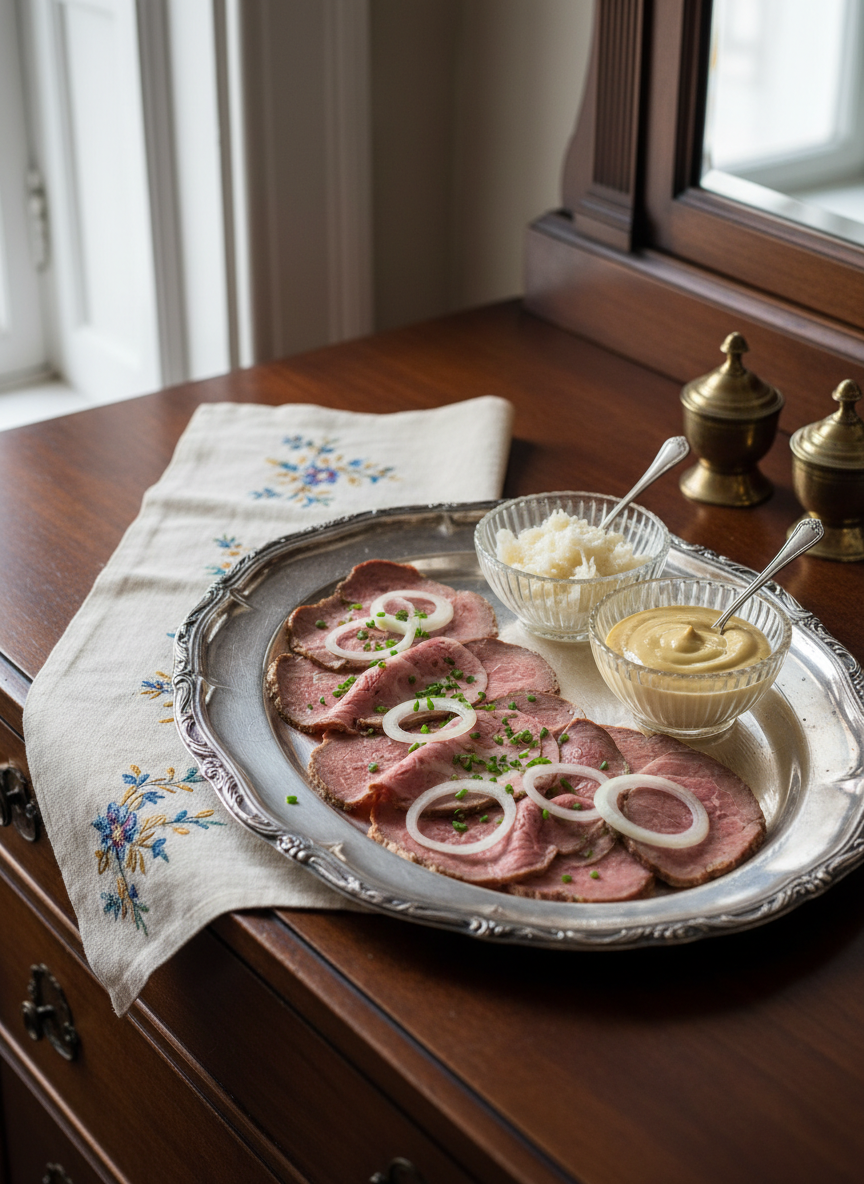
A close-up view of an ornate, slightly tarnished silver platter bearing carefully arranged slices of cold boiled beef, each slice marbled and glistening, garnished with rings of pickled onion and finely chopped chives. Small glass bowls of freshly grated horseradish and a smooth mustard sauce accompany the meat. The platter rests on a dark, polished wooden sideboard alongside a folded embroidered runner and a pair of antique brass salt cellars. Subtle side lighting from a tall, unseen window creates a dignified interplay of light and shadow across the metal and meat surfaces. Photographic realism with a narrow depth of field keeps the platter in crisp focus while the background elements softly fade, evoking refined Jewish German bourgeois dining culture.

Heidl Urmasky

Through these step-by-step Yekke recipes, I finally understand the stories my grandparents told about Shabbat and German-Jewish life.